 The CJ-3A Universal Jeep
by Reed Cary
Direct descendant of the CJ-2A, the Universal Jeep CJ-3A was launched in the Fall of 1948. For the casual observer the 3A differed from the 2A only by its new one-piece windshield. But there were subtler differences: where Willys-Overland had moved the driver seat further back on the 2A, perhaps to accommodate husky farmers as well as thin GI's, they did it again with the 3A.
The windshield was simplified with the wipers at the bottom, and made taller
for more headroom. And the suspension was beefed up a bit, perhaps in answer to
calls from the agricultural community who by now had a wide array of implements
to choose from, designed to be mounted on and operated by a Jeep CJ.
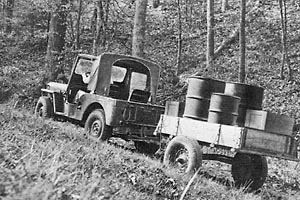 The lack of ads for the CJ-3A except in the farm journals, at the same time as
W-O was lavishly advertising its trucks and station wagons in full-color ads in
the mainstream press, would suggest the community to which the 3A was aimed. The
dash-mounted info plates with their pictures of farm and industry side by side,
also demonstrate the markets in which W-O was hoping for sales.
The lack of ads for the CJ-3A except in the farm journals, at the same time as
W-O was lavishly advertising its trucks and station wagons in full-color ads in
the mainstream press, would suggest the community to which the 3A was aimed. The
dash-mounted info plates with their pictures of farm and industry side by side,
also demonstrate the markets in which W-O was hoping for sales.
Willys-Overland in 1948
Consider the era into which the 3A was delivered. Slumping sales of the 2A in 1947 had perhaps caused Willys-Overland to look for a "new" model. The initial postwar hype for a new "civilian jeep" must have waned considerably, at least in terms of appeal to the broad public. W-O, despite its sales of jeeps during the war years, was still a lean corporation. It did not have the assets to compete in the emerging postwar passenger car market like Ford and GM.
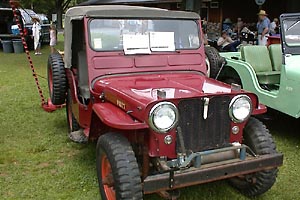 True, Willys had produced the small "Americar" before the war which had sold
fairly well. It had successfully launched itself back into the pick-up market.
And sales of the first all-metal Station Wagon were going well. But a dispute
was raging at W-O about re-entering the passenger car market. Simultaneously,
sales figures show that the market for the CJ was not expanding. So it is not
too surprising, considering also the utilitarian nature of the Jeep CJ, that
redesign was held to a minimum. The photo by Bill Lagler shows Joe Caprio's
all-original 1951 CJ-3A.
True, Willys had produced the small "Americar" before the war which had sold
fairly well. It had successfully launched itself back into the pick-up market.
And sales of the first all-metal Station Wagon were going well. But a dispute
was raging at W-O about re-entering the passenger car market. Simultaneously,
sales figures show that the market for the CJ was not expanding. So it is not
too surprising, considering also the utilitarian nature of the Jeep CJ, that
redesign was held to a minimum. The photo by Bill Lagler shows Joe Caprio's
all-original 1951 CJ-3A.
 One of the postwar developments at W-O prior to the debut of the CJ-3A, was the
consolidation of the production of major parts. Prior to the war, Willys had
been, like most of the other smaller auto manufacturers, primarily an assembler
of parts purchased elsewhere. But the purchase of the Wilson Foundry allowed for
in-house casting of motor blocks. The body fabrication, which had been largely
(if not all) done by American Central, was now also brought in-house, with the
bringing home of the die sets and the acquisition of the presses and other
related machinery to be able to produce the bodies and frames. This might
explain the apparent lack of frame tags and body serial numbers on 3A's.
One of the postwar developments at W-O prior to the debut of the CJ-3A, was the
consolidation of the production of major parts. Prior to the war, Willys had
been, like most of the other smaller auto manufacturers, primarily an assembler
of parts purchased elsewhere. But the purchase of the Wilson Foundry allowed for
in-house casting of motor blocks. The body fabrication, which had been largely
(if not all) done by American Central, was now also brought in-house, with the
bringing home of the die sets and the acquisition of the presses and other
related machinery to be able to produce the bodies and frames. This might
explain the apparent lack of frame tags and body serial numbers on 3A's.
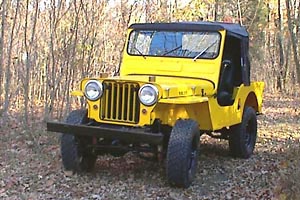
This photo shows Bill Lagler's 3A.
 The U.S. military, who had been experimenting together with W-O on many forms of
"improved" jeeps since before WWII had ended, were apparently undecided on just
what they wanted. The improved version of the "Go-Devil" L-134 engine, the FA
(later the FB version, to become known as the "Hurricane") was, if not in the
works, certainly in the minds of the engineers and on the drawing boards at W-O
in the fall of 1947. So W-O launched its own upgraded civilian Jeep first.
The U.S. military, who had been experimenting together with W-O on many forms of
"improved" jeeps since before WWII had ended, were apparently undecided on just
what they wanted. The improved version of the "Go-Devil" L-134 engine, the FA
(later the FB version, to become known as the "Hurricane") was, if not in the
works, certainly in the minds of the engineers and on the drawing boards at W-O
in the fall of 1947. So W-O launched its own upgraded civilian Jeep first.
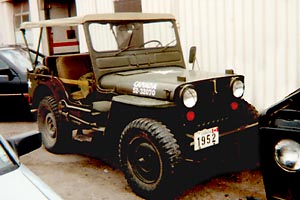
The M38 (photo at left) introduced in the Fall of 1950, as well as the
limited-edition Navy CJV-35, delivered in the Spring of that year, were still
basically military adaptations of the 3A. Photo by Alex Houle.
Changes in the CJ-3A
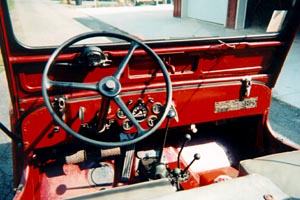 Modification to the body tub, i.e. the reconfiguration from 2A to 3A, was likely
a far-sighted reappraisal, as it seems to have carried over pretty much
unaltered into the model 3B. Basically, these modifications were as mentioned
above: more head room with the increased windshield height, and more "corpus"
room behind the steering wheel, as seen in this photo of Joe Caprio's 3A. This
entailed moving the wheel wells back and a consequential shortening of the rear
deck. Other modifications came along with production. The first 3A's came out
with the 42-2 rear axle, a continuation of the development of the late 2A. In
the Spring of 1951 the rear axle was changed to the 44-2, which has a history of
its own.
Modification to the body tub, i.e. the reconfiguration from 2A to 3A, was likely
a far-sighted reappraisal, as it seems to have carried over pretty much
unaltered into the model 3B. Basically, these modifications were as mentioned
above: more head room with the increased windshield height, and more "corpus"
room behind the steering wheel, as seen in this photo of Joe Caprio's 3A. This
entailed moving the wheel wells back and a consequential shortening of the rear
deck. Other modifications came along with production. The first 3A's came out
with the 42-2 rear axle, a continuation of the development of the late 2A. In
the Spring of 1951 the rear axle was changed to the 44-2, which has a history of
its own.
Smaller changes, such as the starter push-rod set-up, may also have been made to
the model CJ-3A during its production run, but these are undocumented, at least
by this author.
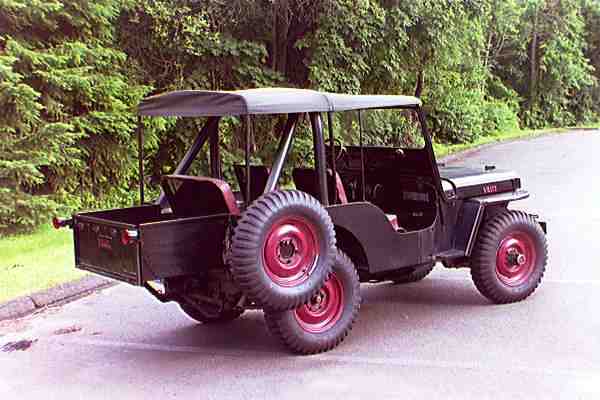
The 3A continued in production into early 1953, overlapping the introduction
of the 3B by several months (and qualifying it as a "Sibling of the CJ-3B").
Total production was approximately 130,000, less than either the 2A or 3B, which
largely accounts for the 3A's relative scarcity on the trails and on the web.
This 1949 CJ-3A was restored by Gary Keating.
Much is still to be learned about that transitional period in 1953, when Willys-Overland was sold to Kaiser-Frazer -- both in regard to the changes in lesser details from the 3A to the 3B, and the inner workings of the company and reasons for transfer of ownership. More information is always welcome.
Special thanks to Reed Cary for the above information.